

COLLECTION
The West Side’sChicana/o/x Activism
Murals in the West Side can be further contextualized by the West High School Walkout and other Chicana/o/x activism starting in the late 1960s. Storytellers discuss their role in organizing, as well as how state violence and the press sought to silence it.

The West High School Walkouts
Storytellers Cathy Prieto and her daughter Desiree Maestas—both of whom grew up in La Alma—talk…

Listen to Cathy Prieto and Desiree Maestas on the West High School Walkout


Gathering in Parks and Police
Students asserting their need to learn their history and taking up space as a group was deemed a “threat” by…
Listen to Lucha Martínez de Luna on police control of parks in La Alma


La Alma Park Name-Change Riot
Civil Rights activist and muralist Emanuel Martínez told the story of the La Alma Park name-change riot…
Listen to Emanuel Martínez on the La Alma Park name-change riot


The West High School Walkouts
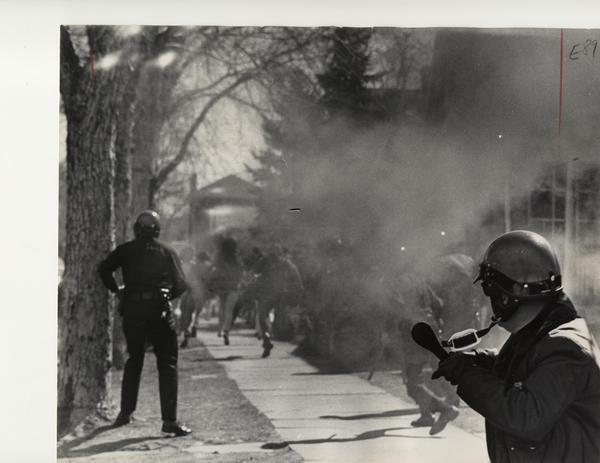
Storytellers Cathy Prieto and her daughter Desiree Maestas—both of whom grew up in La Alma—talk about how the neighborhood was predominantly made up of people of color in the 60s and 70s, the high concentration of police, and the violence police inflicted at the West High School Walkout of 1969. More than 1,200 Denver students demonstrated and demanded bilingual education, the firing of a racist teacher, and for Chicana/o/x history and culture to be included in the district’s curriculum (Fairhill & Co. 2019).
Listen
Cathy Prieto and Desiree Maestas on the West High School Walkout
“The cops tried to make it their deal that they’re gonna stop it, you know, you don’t start violence with a march, you don’t have to come out and beat the people, you talk to ‘em. Because they were just talking in bullhorns, the kids, and trying to get our point across that you know, we need culture in our schools.” Ms. Maestas “mhm'd” in agreement.
Cathy Prieto and Desiree Maestas

Gathering in Parks and Police
Students asserting their need to learn their history and taking up space as a group was deemed a “threat” by police. Many storytellers spoke about police inflicting violence when residents gathered in public spaces around the time of the walkout, such as Lucha Martínez de Luna when she talked about how the police controlled parks in La Alma:
“Sure, we could walk in the park, we could use the space, but it was very much controlled. A lot of times when you were walking through the parks, if there were more than five people congregated in the space, immediately police would come and start harassing you, asking what you’re doing, why are you here... So it wasn’t really a safe space for people in the community, but yet the parks were in their community.”
Lucha Martínez de Luna
Listen
Lucha Martínez de Luna on police control of parks in La Alma
Even though 80% of people living in La Alma were Chicana/o/x in 1970, the school curriculum and police treated residents as outsiders of their own neighborhood (2019). Racist forces sought to control, keep quiet, and isolate neighborhood residents.

La Alma Park Name-Change Riot
Civil Rights activist and muralist Emanuel Martínez told the story of the La Alma Park name-change riot, where police corralled and dropped tear gas from a helicopter on a crowd of celebrating residents who decided to change the name from Lincoln Park to La Alma Park, replacing a sign without city approval. Rocky Mountain News publicized residents as “hoodlums rioting,” and police denied using tear gas.
Listen
Emanuel Martínez on the La Alma Park name-change riot

When claiming ownership over and naming their own spaces, city officials felt a need to shut down residents’ gathering and made the neighborhood unsafe. Systemic racism in schools, parks, and police violence is important to understand the broader context of oppressive power in La Alma. Still, it does not singularly define Chicana/o/x residents of the 1960s or now.
