

COLLECTION
Casa Mayan's History of Inclusion in Auraria
Just north of La Alma, Auraria’s working-class neighborhood of predominantly Hispanos, Mexican Americans, and Latinos experienced similar tensions between control imposed by systemic racism and celebrations of culture and interconnectedness in the community. In Auraria was Casa Mayan, one of Denver’s first Mexican restaurants and a cultural space for people to gather during the early days of the Chicana/o/x Movement.
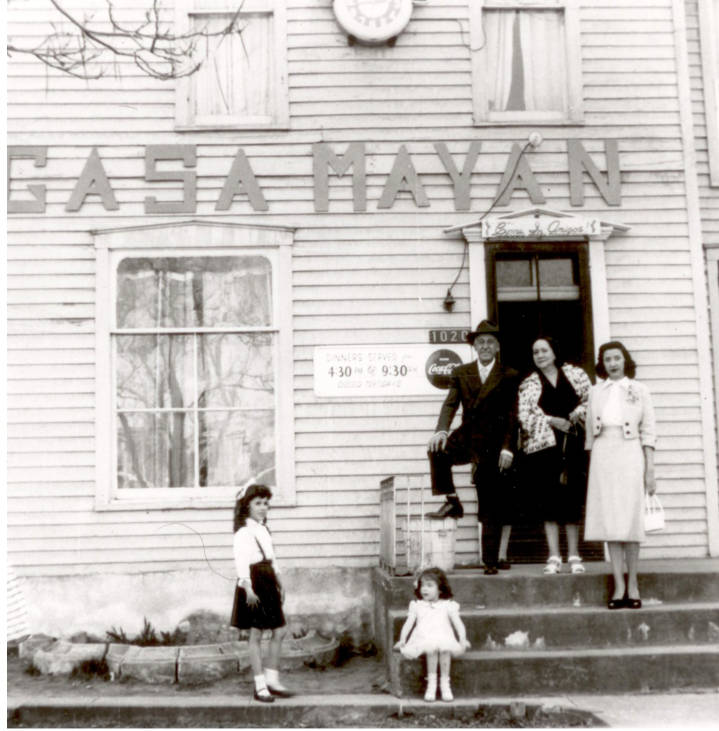
Mr. Alcaro’s grandparents stand on the front steps of Casa Mayan, next to a sign that reads “Dinners served from 4:30 PM til 9:30 PM Closed Tuesdays.” 1958. Photo courtesy of Gregorio González Alcaro.
After growing up in Auraria with his mother and grandmother running Casa Mayan, Gregorio González Alcaro spoke to me about how anyone was welcome inside and would be treated equally. A paper sign on the front of the house reads “In Lak’ech Ala K’in,” or “I am you, and you are me” in the Mayan language, as Mr. Alcaro’s grandfather was Mayan and fled Chihuahua during the Mexican Revolution.
Connecting with all different kinds of people (across race, socioeconomic class, gender, religion, etc.) was a core value for the matriarchs who ran the house:
“This house was extremely liberal in opening up to different people, and sharing and giving [but] the rules were very strict that when you came into that house, or at the table to share food, there was not going to be any gossip. You could share what you learned and ideas, but what was prohibited here was gossiping.”

Lucha Martínez de Luna

Listen
Lucha Martínez de Luna on the significance of murals

A collage of prominent actors, musicians, politicians, and otherwise notable individuals who visited Casa Mayan during its time as a restaurant starting in the 1940s until the 1970s. Collage courtesy of Gregorio González Alcaro.
Supporting others was so important that the women leaders of Casa Mayan instituted a no-gossiping rule as their own internal control of the community.

Auraria's Forced Displacement
In the late 1960s and early 1970s, Aurarians were forcibly displaced after city and state officials had been planning for years (without the involvement of residents) to create a consolidated college campus in place of Auraria’s neighborhood (Fairfield & Co. 2019).
Mr. Alcaro described that to justify the mass displacement, urban planners assessed Auraria through imposed standards informed by Western constructs of how a neighborhood ought to look. Despite a lack of investment in the neighborhood, Aurarians shared resources and actively maintained bonds with one another. Through practices such as an economic bartering system, there was practical interdependence. To urban planners, these internal systems were overshadowed by underfunded and deteriorating infrastructure:
"Physical decay is not social decay."

Gregorio González Alcaro
Audio
Gregorio González Alcaro on Auraria’s community networks and forced displacement
Instead of seeing the intricate systems in place that made Auraria’s thriving social fabric, city officials only saw it in the ways it lacked compared to White, wealthy neighborhoods. Planners then used these imposed standards to justify the construction of AHEC at the expense of the community’s connections and systems of mutual flourishing.
Since Auraria’s mass displacement, Chicana muralist Karma Leigh attended Metropolitan State University at the Auraria Higher Education Campus and told me that even though she loved the experience of studying there, Auraria’s history of displacement often goes unseen:
“A lot of people don’t realize or recognize that Auraria was really one of the first majorly gentrified neighborhoods in Colorado.”

Karma Leigh
Audio
Karma Leigh on Auraria’s displacement and gentrification
